
Criminal Cases in Stonewall County Courts
Stonewall County criminal cases divide by charge level. The 39th District Court has general jurisdiction and hears felony prosecutions for a four-county district that also includes Haskell, Kent, and Throckmorton counties. The constitutional Stonewall County Court ordinarily handles Class A and Class B misdemeanors. Fine-only misdemeanors and related warrant matters may remain with the Stonewall Justice Court or an active municipal court. A search must therefore follow the court named on a ticket, bond sheet, complaint, or other case paper rather than assume every criminal case sits in the district docket.
The combined District/County Clerk is the main custodian for filed felony and county-misdemeanor records. The clerk's file may contain the cause number, charging instrument, docket entries, hearing settings, motions, orders, judgment, sentence, and costs. The Justice Court keeps its own lower-court records. No standalone Aspermont Municipal Court portal was verified, so confirm that route through the city or county offices before treating a missing county file as a missing case.
Jurisdiction also explains why one name can require more than one request. A felony indictment belongs in district court. An information commonly charges a misdemeanor in county court. A complaint can support an early hearing or lower-court matter. A capias or bench warrant may arise after a missed setting or a court directive. Ask the clerk to search the court that could lawfully hear the charge, then check a lower court when the papers point there.
Stonewall County has no county court at law. Its constitutional County Court fills the usual Class A and B misdemeanor role, while the one countywide Justice Court addresses fine-only matters within its jurisdiction. This sparse structure can be easier to navigate once the offense level is known, but it punishes a broad name-only search. State the case type and likely court in the first call.
Stonewall County Felony Case Files
The Stonewall County district-clerk page routes felony record questions to the combined clerk and links the 39th District Court. That local route matters because the district serves four counties. A case filed in another district county does not become a Stonewall County criminal case merely because the same district judge or prosecutor serves it. Confirm the county, court, and cause number on each docket.
The clerk works at 128 Town Square Lane, Aspermont, Texas 79502, and receives mail at Drawer P, Aspermont, Texas 79502. Call 940-989-2272 or use holly.mclaury@stonewallcountytx.org. Counter hours are Monday through Thursday from 8:00 a.m. to 4:30 p.m. and Friday from 8:00 a.m. to noon, with a noon to 1:00 p.m. lunch closure. Ask whether the Stonewall County court case is electronic, paper, archived, or inspection-only before planning a visit.
The official clerk page shows the best first stop for a Stonewall County felony file.
View the source for the combined clerk contact before using the office details shown here.

The image reinforces that direct clerk contact, not an unverified case database, is the county access point.
The district-clerk source also identifies the Stonewall County felony route.
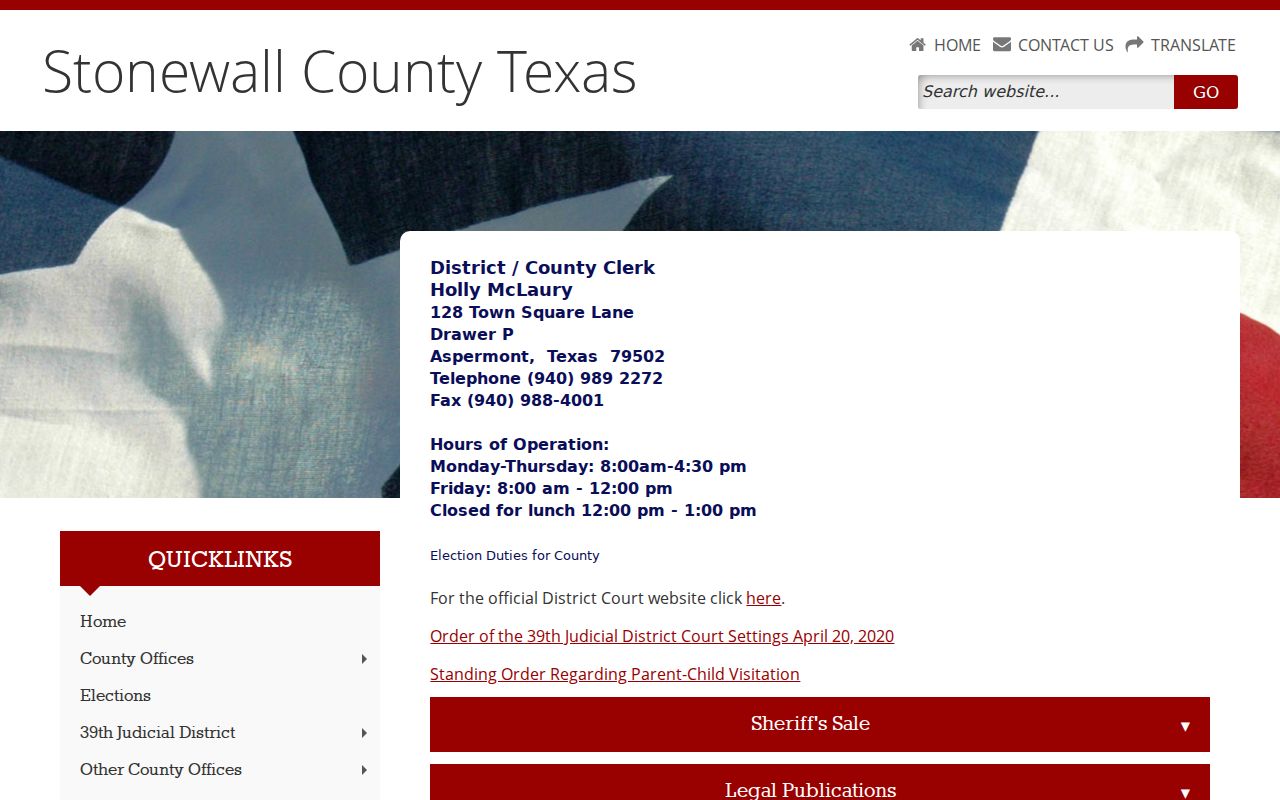
This view connects local filings to the 39th District Court while keeping the clerk as record custodian.
A request can be short and precise. State the full legal name, approximate filing year, offense level if known, and cause number when available. Then name the exact items needed. A docket sheet provides the event trail. The charging instrument identifies the prosecuted offense. The judgment and sentence show the result. Asking for those items reduces the risk of receiving only an index entry that lacks the Stonewall County case outcome.
Plan around the published counter schedule. Friday service ends at noon, and the office closes for lunch on the other listed workdays. The research found no public rules for parking, screening, recording devices, lockers, or detailed accommodations. Call before bringing equipment or planning an inspection that may take time. The clerk can also say whether a document may be emailed or must be inspected or copied at the courthouse.
How to Search Case Records
No verified self-service Stonewall County criminal docket was found. A thorough search begins by calling the combined clerk and naming the court level. It then branches to the Justice Court or a confirmed municipal court for fine-only matters. re:SearchTX is only a supplement because public criminal coverage has historically been excluded or limited. A statewide no-result does not clear a name or disprove a local paper file.
- Decide whether the Stonewall County court case is a district felony, county misdemeanor, or fine-only matter.
- Give the clerk the cause number. If it is unknown, provide the full legal name and approximate filing year, then ask what other identifier the office accepts.
- Request the docket sheet, charging instrument, disposition or judgment, sentence, and register of actions rather than a vague background check.
- Ask which pages are public, whether the file is archived, and whether inspection or electronic delivery is available.
- Get a written quote for plain or certified copies and confirm the accepted payment method before ordering.
The re:SearchTX interface may expose the following fields after access. Confirm that a result is a Stonewall County criminal case with the clerk.
| Field Label | Type | Required | Notes |
|---|---|---|---|
| Party or person | Text | Varies | Name searches can require added facts to avoid a false match. |
| Case number | Text | No | The most direct route when the full cause number is known. |
| Court or county | Select | No | Choose Stonewall and confirm the specific court. |
| Case type | Select | No | Criminal availability must be verified rather than assumed. |
| Filing date | Date range | No | A narrow year or range can reduce unrelated results. |
Search fields are leads, not identity proof. Similar names can produce the wrong person, while a nickname, old spelling, or incomplete date can hide the right file. Compare the court, cause number, filing year, charge, and disposition before relying on a result. When the search concerns one's own record, the clerk can explain which identifier it accepts for a more exact local match.
When the cause number is missing, start with a narrow year and the court level. Ask the clerk to read back enough nonrestricted data to distinguish possible matches. Once the right cause is found, place that number on all later requests. It ties the docket, copies, payment question, and archive retrieval to one Stonewall County criminal case and cuts down on repeat name searches.
Stonewall County Case Portal Limits
re:SearchTX is a statewide electronic court-document system, not a complete Stonewall County criminal case index. Texas court reporting documented limits on criminal material available to public users. The clerk's online records link also appears oriented to recorded instruments. Neither tool should be described as a county criminal clearance search. Use an online hit as a lead and a no-result as a reason to call the right clerk.
The official re:SearchTX home screen shows the statewide search layer.
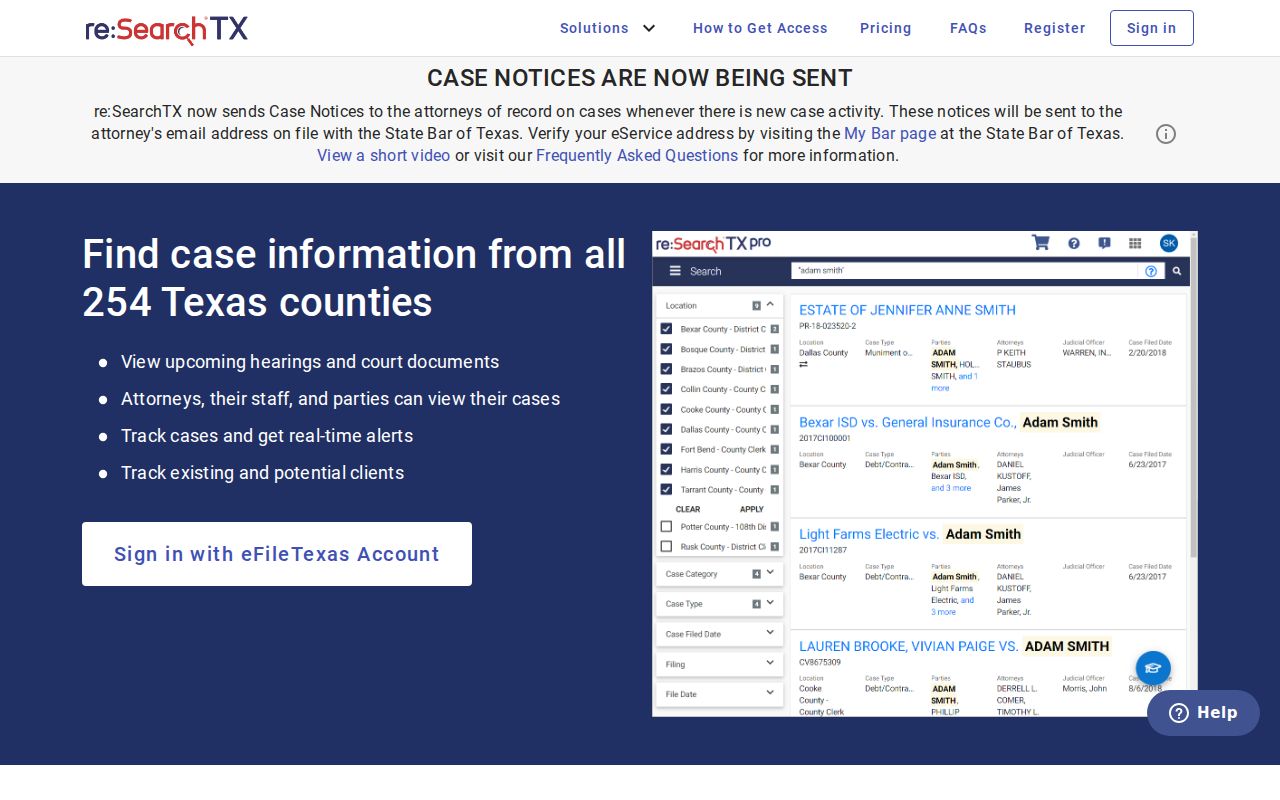
The portal can supplement local work, but it cannot replace confirmation of Stonewall County criminal files.
The Texas Court Directory solves a different problem by locating the current court, clerk, judge, or coordinator.
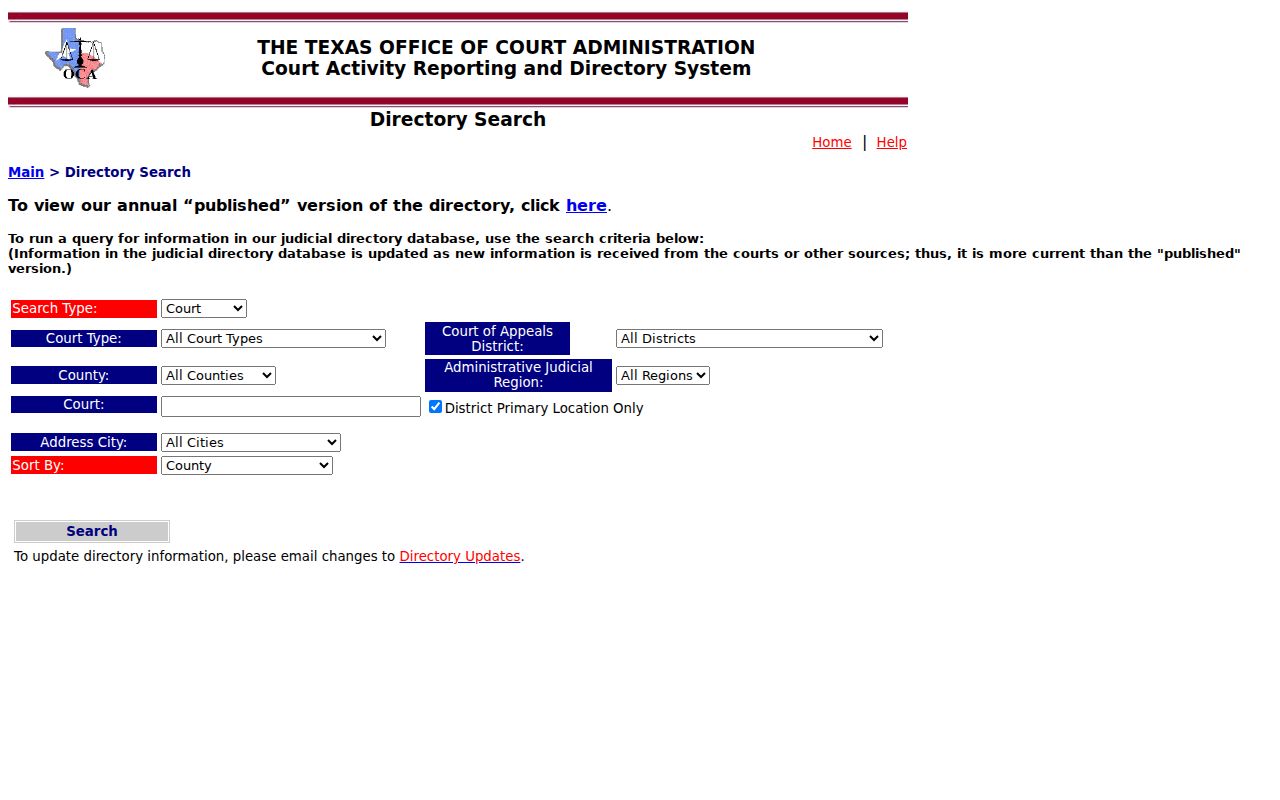
Directory results help route a request; they are not docket results or proof of a case outcome.
The directory's county, region, court, and district-primary-location controls can identify a current office even when a local link has changed. That is useful before a hearing or record request. It does not show a party, charge, plea, or judgment. Keep the task clear: use the directory to find the custodian, re:SearchTX to test for eligible electronic material, and the Stonewall County clerk to confirm the criminal case file.
Older or paper-only records require the same discipline. Ask whether the clerk must retrieve an archive, how long retrieval may take, and whether inspection can occur at the counter. No archive coverage date is published. No criminal search, copy, or certification charge is posted either. Request the cost before ordering, especially when a long docket includes many pleadings.
A plain copy and a certified copy serve different needs. A plain copy is useful for reading and reconciling the case. A certified copy bears the clerk's official certification and may be needed for a formal filing or agency correction. Stonewall County does not publish either price. Describe the purpose to the receiving office, not to justify access, but to learn which copy type that office requires before paying.
What the Case File Shows
A Stonewall County court case file records what prosecutors filed and what the judge did. The header can show the cause number, State of Texas case style, court, filing date, case type, status, and judge. The charge area may list the alleged offense, statute, degree or class, offense date, and the date of the complaint, information, or indictment. A complete reading follows the docket through its last entry. It does not stop at the first charge.
| Case Number & Court | Identifies the cause and whether a district, county, justice, or municipal court holds it. |
|---|---|
| Charging Document | The complaint, information, or indictment states the charge that entered the court file. |
| Docket Entries | Track settings, motions, pleas, trials, judgments, revocation actions, and appeal notices. |
| Hearing Dates | Show scheduled or completed court events, subject to later resets and orders. |
| Disposition & Judgment | Records dismissal, acquittal, conviction, deferred adjudication, or another final action. |
| Sentence & Conditions | May show confinement, credit, fine, costs, restitution, and community-supervision terms. |
Party information can include the State, the defendant, the prosecutor, and defense counsel. Full birth dates, Social Security numbers, and home addresses should not be expected in a public copy. Bond entries may show amount, type, conditions, forfeiture, or a capias. Financial entries may list a fine, costs, restitution when public, and collection status. Document images still depend on digitization and legal access, so a docket entry does not guarantee that the linked pleading can be viewed online.
For a clear Stonewall County case summary, capture four facts: the filed offense, the plea or trial result, the disposition date, and the sentence. Also note any later motion to revoke, motion to adjudicate, amended judgment, or appeal. Those later events can change how the case should be described. The initial arrest wording is not a safe substitute for the final court record.
Companion causes and appellate cause numbers can split a matter across files. A docket may also refer to a warrant or capias without reproducing every law-enforcement record. Follow each cross-reference only when it bears on the outcome being checked. The goal is a coherent Stonewall County case trail, not a pile of unrelated pages that share a name.
Reading Stonewall County Case Outcomes
A disposition is the case outcome, not the first allegation. A conviction is a judgment of guilt. An acquittal is a not-guilty outcome. A dismissal ends the charge without a conviction, though it does not erase the booking or the earlier docket. Deferred adjudication follows a guilty or no-contest plea while the court defers a finding of guilt during community supervision. DPS says deferred adjudication can remain in its public conviction database unless it is legally restricted.
- Indictment
- A grand jury's felony charging instrument, also called a true bill.
- Information
- A prosecutor-filed charging instrument commonly used for a misdemeanor.
- Capias
- A court-issued writ directing an arrest, often tied to a missed step or later case action.
- Judgment
- The signed court record of the result and, when applicable, the sentence.
Compare the judgment with the filed charge because the offense class or wording can change before the Stonewall County criminal case ends.
Community supervision is the Texas term used for probationary court supervision. Straight community supervision follows a conviction, while deferred adjudication delays the formal finding after a plea under court-set terms. A motion to revoke or adjudicate does not itself prove the final result. Read through the hearing and signed order. The same care applies to a dismissal on the State's motion, which ends the charge but does not by itself remove all arrest and repository records.
Bond terms also need context. A cash bond uses the full amount as security. A surety bond is backed by a qualified surety, and a personal bond relies on a promise and court-set conditions rather than the usual cash or surety security. A forfeiture or capias entry can signal later action. It does not state the final Stonewall County case result, so continue to the latest signed order.
Stages of a Criminal Case
The arrest and booking may precede a court file, but the prosecution begins with a filed charging instrument. At arraignment, the accusation is addressed and a plea is taken. Pretrial work can add motions, settings, bond orders, discovery issues, and negotiated plea terms. A trial may end in conviction or acquittal. A plea can also produce a judgment or deferred adjudication. The disposition and sentence appear near the end of the docket, while later revocation or appeal entries may extend the record.
Case flow: Charges Filed › Arraignment › Pretrial › Plea or Trial › Disposition › Sentencing
Stonewall County publishes no standard duration for each stage, so do not infer delay or closure from the age of one docket entry.
Grand-jury action is another key branch. A true bill produces an indictment; a no bill means the accusation was not indicted. Grand-jury deliberations stay secret even when the filed result becomes part of the public case trail. Misdemeanor charges may proceed by information instead. These distinctions explain why an arrest allegation and the clerk's charging instrument can bear different text or legal classes.
After a plea or verdict, the court may impose confinement, jail credit, a fine, costs, restitution, or community-supervision terms. Later appellate or supervision filings can add more docket events. For that reason, request the current register of actions rather than a docket printed at an unknown past date.
Stonewall County Case Search Without Number
A missing cause number does not end a Stonewall County criminal case search. Call the combined clerk with the full legal name, approximate filing or arrest year, and likely offense level. Ask whether the office can search district and county indexes by name and what added identifier it accepts to distinguish similar people. Do not email a full Social Security number or other sensitive data unless the clerk directs its use through a secure method.
If the clerk finds no district or county case, follow the jurisdiction. A fine-only matter may remain in the Justice Court or a confirmed Aspermont municipal court. A federal cause belongs in the Northern District of Texas. An arrest without a filed charge may produce sheriff or agency records but no clerk case. Write down which indexes and date spans were checked, then use any later-found cause number to order the docket, charge, judgment, and sentence.
Stonewall County Criminal Charge Routes
The prosecutor route follows the court. The 39th Judicial District Attorney handles district felony matters across the shared district. The Stonewall County Attorney performs county-level prosecution duties assigned under Texas law. Their records do not replace the clerk's docket, but the office named on a filed paper can help explain why an allegation moved from an arrest report into one court instead of another.
The official Stonewall County Attorney page identifies the local misdemeanor prosecutor contact.
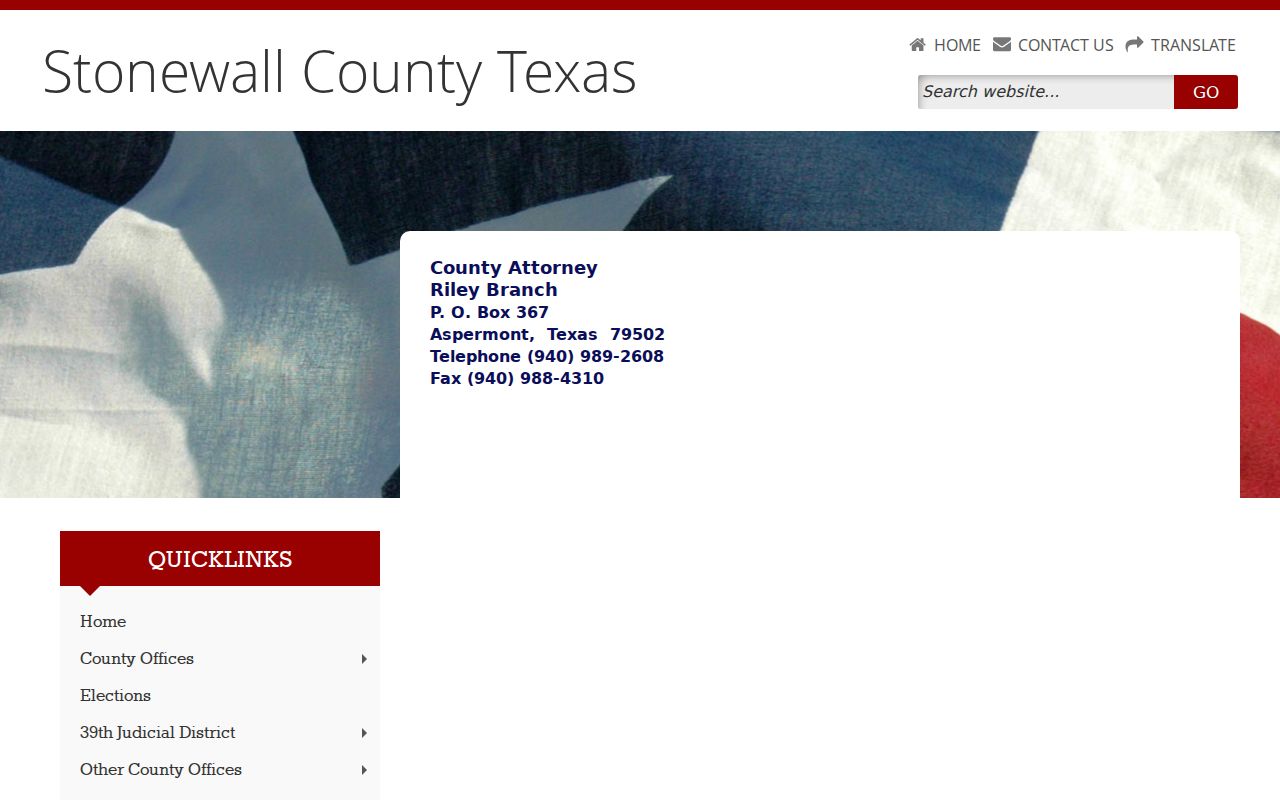
This office context helps separate county misdemeanor filings from 39th District felony matters.
A federal prosecution is separate. Stonewall County lies in the Northern District of Texas, and its federal docket does not sit with the county clerk. The PACER system is the official federal docket channel.
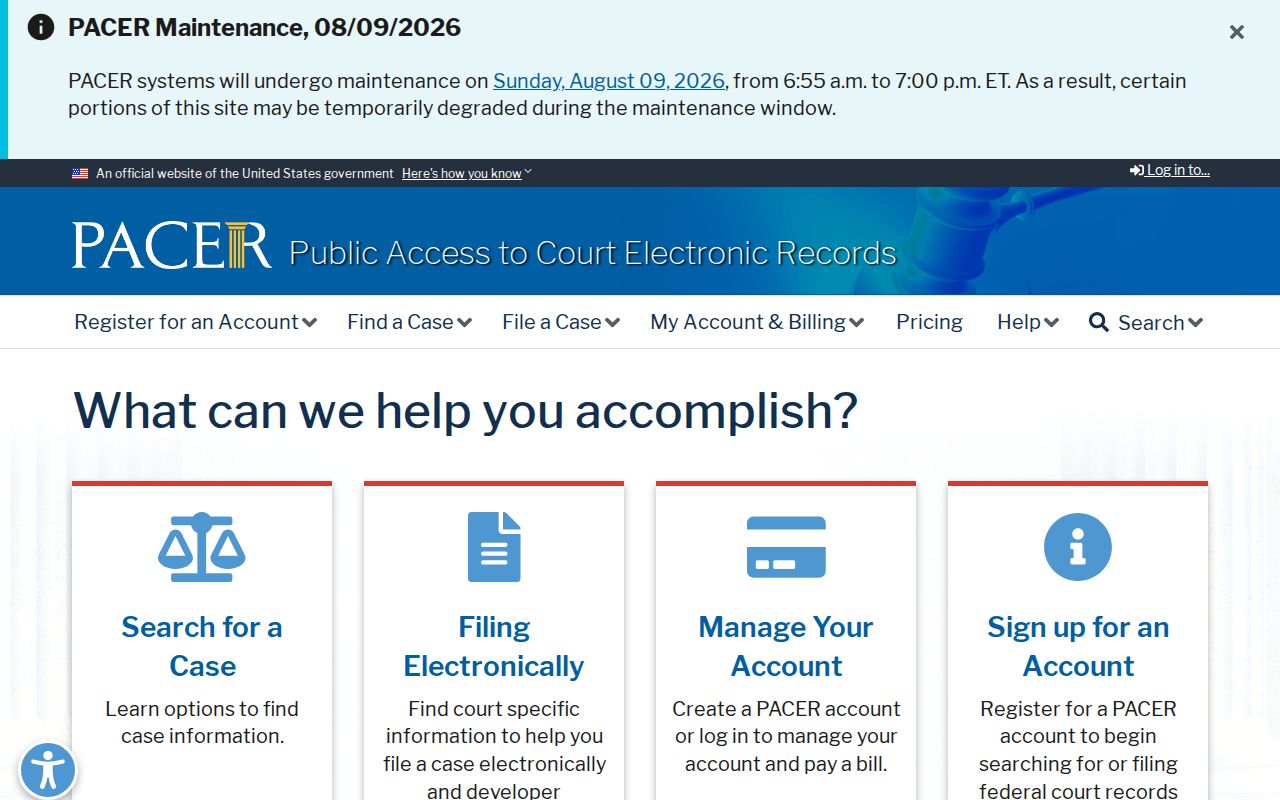
The federal search image marks a firm boundary between county court records and a Northern District of Texas case.
Prosecutor contact pages help with office routing but are not a substitute for the judicial record. The clerk controls access to the filed instrument and signed order. The prosecutor may hold work product or active investigative material that is not in the public court file. For appointed-counsel questions, the magistrate or trial court supplies the process. Stonewall County publishes no standalone public defender office, so the clerk should not be asked to decide eligibility.
The district attorney contact should be reconfirmed because officeholders and routes can change. Current official sources identify the district prosecutor through the 39th Judicial District. County Attorney Riley Branch is listed at P.O. Box 367, Aspermont, with telephone 940-989-2608. Use those contacts for their proper prosecutorial roles, while sending copy requests to the clerk.
Access & Restrictions
Texas court files are obtained from the clerk under the court-record framework, which does not always work like an executive-agency request under the Texas Public Information Act. Public access can still be limited by a sealing order, expunction, order of nondisclosure, juvenile confidentiality, or a statute that protects victim, medical, biometric, driver's-license, Social Security, and other identifying data. A redacted copy may therefore differ from the courthouse's full judicial file.
If a Stonewall County criminal case does not appear online, ask the clerk whether it is paper-only, archived, sealed, expunged, nondisclosed, filed under a different name, or held by a lower court. Ask for segregable public pages instead of assuming the entire file is closed. The county publishes no criminal copy, certification, or archive retrieval fees. Obtain a quote and ask whether the requested page must be certified for its intended official use.
Expunction under current Texas Code of Criminal Procedure Chapter 55A is not the same as an order of nondisclosure under Government Code Chapter 411. Expunction can direct destruction, deletion, return, or confidential retention as the law and order require. Nondisclosure generally blocks ordinary public release while preserving access for listed agencies. Eligibility is outcome-specific. A bare dismissal label does not establish that a Stonewall County file should already be absent.
Juvenile law-enforcement records receive separate protection under Family Code Chapter 58. Victim identity, health details, biometric data, driver's-license data, and Social Security numbers can also be withheld or redacted. If a clerk provides a shorter public copy than expected, ask which page or field is restricted and whether a redacted version of the rest can be released.
Texas Government Code Chapter 411 separately controls criminal-history record information held in the state repository. That rule does not turn the DPS public name search into the Stonewall County clerk's docket. For the most accurate account of a local prosecution, use the court's charge, docket, judgment, and sentence. For one's own statewide identity history, use the official fingerprint-review path and correct any missing disposition through the reporting agency and DPS.
Note: A missing portal result is not proof that Stonewall County has no court file for the name searched.